ពុទ្ធំ​​ ធម្មំ សង្ឃំ​​​ សរណំគច្ឆាមិ សូមដល់ព្រះពុទ្ធ ព្រះធម៌ និងព្រះសង្ឃជាទីពឹងទីរលឹក

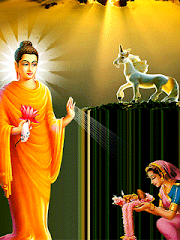
ចង្ហាន់នាងសុជាតា

ចង្ហាន់នាងសុជាតា
សូមទស្សនានៅបណ្ដាញនេះ ពី​ ភិក្ខុធម្មបាលោ ថនប៊ុនថុន

ចំណងជើងអត្ថបទដែលសរសេរជាលេខសូមចុចនៅលើវាដើម្បីតាមដានបន្តទៀត

ព្រះពុទ្ធជាម្ចាស់ទ្រងង់សម្ដែងព្រះបាតិមោក្ខ

ព្រះពុទ្ធជាម្ចាស់ទ្រងង់សម្ដែងព្រះបាតិមោក្ខ
ដល់សាវករបស់ព្រះអង្គនៅវត្តវេឡុវ័ន

សូមឲ្យព្រះពុទ្ធសាសនារុងរឿងចំរើនឡើងជារៀងរហូត

ប្រធានបទរបស់វេបសាយ៍

วันจันทร์ที่ 11 มกราคม พ.ศ. 2553

Maditation and sciencet

Meditation is both an ancient spiritual practice and a contemporary mind-body technique for relaxing the body and calming the mind. Most meditative techniques have come to the West from Asian religious practices, particularly India, China, and Japan, but similar techniques can be found in many cultures around the world. Until recently, the primary purpose of meditation has been religious, although its health benefitshave long been recognized in these cultures where these methods originated.

In the West, the first view was that meditation induced a type of dissociative state or a type of catatonia. Thirty years ago, meditation was still considered a religious practice, not appropriate for healthcare settings. The first articles on the health benefits of meditation appeared in the Journal of Transpersonal Psychology in 1970. Meditation is the first mind-body intervention to be widely adopted in mainstream health care. Meditation is now widely taught at medical settings such as the VA clinics and Kaiser Permanente where it is prescribed as a technique for relaxing the body and calming mind.

The search for the true self through the meditative process is not something recently discovered, nor is it in any way alien to the basically rationalistic philosophical and spiritual traditions of the West. Although Western civilization has for the most part directed its energies outward in various efforts to control and exploit the resources of nature, there have always been inner-directed philosophers, saints, and mystics who have dedicated themselves to a higher purpose than material well-being, which is in all cases temporary.

วันศุกร์ที่ 8 มกราคม พ.ศ. 2553

4.the Meditation

Any of us have at one time or another found the toll of living in the modern world hard to bear. Stress, depression and disillusionment are some of the diseases of modern times that leave us yearning for a solution, a cure, so to speak. More and more people are turning to meditation as they fail to find the answer through worldly paths.

Meditation is found in some form or other in all major religious traditions. Even those who are not religious use it to focus the mind, to hone it, so that it works better. In Buddhism, meditation is the integral to the eight-fold path to enlightenment. One trains one’s mind so that it can see the four-point Supreme Truth that forms the core of Buddha’s teachings: suffering, what causes it, the end of suffering, and the path to that end. Even if you are not interested in Buddhism, meditation is a valuable training that can be applied to daily life, for it helps with concentration and when done correctly can lead to a state of peace and calmness that’s beyond worldly joys.

There are two main banches in Buddhist meditation: samatha (calmness, concentration) and vipassana (insight), which stresses mindfulness. This doesn’t mean that the two are entirely separate, since you cannot be mindful unless you have at least some level of concentration.

The techniques of samatha meditation are many, some older than Buddhism, others developed after the time of the Buddha. Among the most commonly practiced here is anapanasati, or “mindfulness with breathing.” This technique was advocated by the Venerable Buddhadasa Bhikku (1903-1993), founder of Suan Mokkh Forest Monastery in Surat Thani. Meditators at Suan Mokkh (Garden of Liberation), follow the 16 steps of anapanasati as laid down in Pali texts.

Mantra meditation, in which you repeat a few words over and over, is also widely practiced. Followers of this technique may chant “Buddh” as they inhale, and “dho” as they exhale. The words may vary, but the purpose of chanting is really to get the mind focused. Yet another widely taught technique is kasinas, where meditators concentrate on an object outside themselves, such as the flame of a candle, or a crystal ball.

Buddhist

Sati, or mindfulness, is key to vipassana meditation. You train yourself to be aware of the body’s action, the rise and fall of your chest as you inhale and exhale, the movement of your feet and legs as you walk, as well as your feelings, your thought, and finally, the state of mind you are in. Walking, sitting and lying meditation are but a few of vipassana techniques. When the mind is untrained, concentration can be shattered by the slightest stimuli -noise, smell, heat, hunger, pain, etc. The key is to become aware of what happens, but not dwell on it. Still, a novice can only ward off so much distraction, and that’s one reason why vipassana retreats are usually held in peaceful and isolated settings.

Meditation teachings are widely available in Thailand. You can attend a class at one of the teaching monasteries for an afternoon or evening. Wat Mahadhatu near the Grand Palace, for example, has two meditation training centers open to locals and tourists. Or you may join a vipassana retreat, which usually takes a weekend or longer. A number of retreat centers, most of them located in the provinces, run intensive courses of up to four weeks on an ongoing basis. All vipassana retreats require you to follow the Five Buddhist Precepts. These include refraining from harming all living beings, from taking what is not given, from improper sexual behavior, from lying and incorrect speech, and from taking liquors and drugs that will cloud the mind. Some retreats may require that you take you take the Eight Precepts, which in addition to the first five include refraining from dinner, from all forms of entertainment and bodily decoration, and from sleeping on high mattresses.


วันพุธที่ 6 มกราคม พ.ศ. 2553

1 .Conception and birth


Siddhartha was born in Lumbini[11] and raised in the small kingdom or principality of Kapilvastu, both of which are in modern day Nepal. At the time, a multitude of small city-states existed in Ancient India, called Janapadas. Republics and chiefdoms with diffused political power and limited social stratification, were not uncommon amongst them, and were referred to as gana-sanghas.[12] The Buddha's community does not seem to have had a caste system. It was not a monarchy, and seems to have been structured either as an oligarchy, or as a form of republic.[13] The more egalitarian gana-sangha form of government, as a political alternative to the strongly hierarchical kingdoms, may have influenced the development of the Shramana type Jain and Buddhist sanghas, where monarchies tended toward Vedic Brahmanism

วันอังคารที่ 5 มกราคม พ.ศ. 2553

verses for praying homage tothe triple Gem Buddha , Shanga ,Dhamma, s


These verses are recited to pay homage to the Triple Gem - Buddha, Dhamma and Sangha. These words explain some of the great qualities and virtues pertaining to the Triple Gem. By reciting these words, one can understand the admirable qualities of the Triple Gem and so develop one's confidence in their intrinsic worth.

The Buddha himself explained these qualities in many of His Suttas. He also advised his followers to recite these words to be mindful of the Buddha, Dhamma and Sangha in times of fear or disturbance, whether arising from external sources or through evil influences so that such disturbances can be vanquished. This is because the Buddha, Dhamma and Sangha are free from all kinds of defilements and hindrances such as greed, anger and ignorance.

Buddhism and society


Every evening after chanting the Bhavana Society has some program, either a Dhammma talk by one of the senior monks, a sutta presentation by a community member, a discussion about the Dhammapada, Pali study or a book report. Last night I volunteered to give a sutta presentation. Instead of reporting about one sutta I decided to discuss the topic of stream-entry, or the first stage of enlightenment, as it is discussed in the suttas. There is some interesting information in the suttas and I wanted to get Bhante G’s opinion about some of the material. He is in California right now, so Austin and I gave a talk about the pilgrimage instead.

It was good for me to talk about the pilgrimage, as yesterday we decided not to wait until July 5th to make a decision about the walk. Ajahn Punnadhammo and I spoke on the phone and he is very enthusiastic about my returning to Arrow River and said as long as I can carry my own water and spilt my own firewood he saw no problem with my coming to stay. So Austin and I are in the process of looking into what to do after June 22nd, which is when we will be leaving the Bhavana Society.

It is ironic that we decided to end the walk one week after mentioning we were at the midpoint between March 1st and August 20th (the day the pilgrimage had to be completed). We still have about five or six weeks before we plan to reach Thunder Bay and I anticipate continuing to write about our experiences until we get there.

If my health is still not improved Dr. Jerry invited us to come stay with him in Lafayette, Indiana and he will run a series of tests on me. From Lafayette we might take a train to Minneapolis, Minnesota and stay with a meditation group in the area. Father William will be away until July 5th, and we want to end the pilgrimage with a visit to St. John’s Abbey. Father William has offered to drive us to Thunder Bay, Ontario.

It is interesting to me that on the day we finally decided to end the walk, the batteries in my L.E.D. flashlight finally died. Those were the batteries that I installed in the lamp back in mid-February right before leaving Thunder Bay.

When we left New Orleans I had fifteen contacts along the proposed route. Austin had a few more. Today as I look at my address book I count fifty-eight, and that doesn’t count the dozens of people who wrote just to express good wishes! We certainly were blessed with support.

I like the way Father William summed up my explanation about exploring the sadness of facing the end of the pilgrimage. Here is what he wrote, “They weren't at all the events you anticipated, but they have, in their own way, been moments of great grace. The last words of Georges Bernanos' novel, The Diary of a Country Priest, say it all. "Tout est grâce." Everything is grace.

Touche!


the doctor's prescription
A man becomes sick and goes to the doctor for help the doctor examines him and then writes out a prescription for some medicine. The men has great faith in his doctor. He returns home and in his prayer room he puts a beautiful picture or statue of the doctor. The he site down and precept to that picture or statue he site down three time , and offers flower and incense, and then he take out the prescription that the doctor wrote for him ,and every solemnly he recites it . two pill in the morning , two pill the after noon m, two in the evening ! all day , all life long he keep reciting the prescription because he has a great faith in the doctor , but still the precondition doest not help him .
the man decided that he wants to know more about this prescription ,and so he run to the doctor and ask him . why did you prescription this medicine ? how will it help me ?being an intelligent person , the doctor explains , well look this is the root cause of your disease . if you take medicine i have prescription it will eradicate the cause of your disease . when the cause eradicated , the disease will automatically disappear , the man thinks , Ah wonderful !and he goes home and starts fighting with his neighborer and acquaintances, insisting , ! doctor is the best the doctor all the doctor are useless . but what does he gain by such arguments? all his life he may continue fighting but still this does not help him at all if he take the medicine .only the then man be relived of his misery,

วันจันทร์ที่ 4 มกราคม พ.ศ. 2553

QUESTION: I often hear Buddhists talk about wisdom and compassion. What these two terms mean?
ANSWER: Some religions believe that compassion or love ( the two are very similar ) is the most important spiritual quality but they fail to develop any wisdom. the result is that you end up being a good-hearted fool, a very kind person but with little or no understanding. Other systems of thought, like science,m believe that wisdom can best be developed when all emotions, including compassion, are kept out of the way. the outcome of this is that science has tended to become preoccupied with results and has forgotten that science is to serve man, not to control and dominate him.k How, otherwise, could scientists have lent their skills to develop the nuclear bomb, germ warfare, and the like.Religion has alway seen reason and wisdom as the enemy of emotions like love and faith. Science has alway seen emotions like love and faith ad being enemies of reason and objectivity. And of course, as science progresses, religion declines. Buddhism. on the other hand, teaches that to be a truly balanced and complete individual, you must develop both wisdom and compassion. And because it is not dogmatic but based on experience , Buddhism has nothing to hear from science.